How to keep every report claim traceable to its source
Traceability
A working method for keeping every claim in a report linked to the source behind it, from intake to sign-off.
We built a public archive of every Premier League season since 1992/93 as our own project. Each figure on it, from a single result to a league table or a study, carries the source it came from, the day it was imported and the method behind it. We used football because the data is public, large and argued over, which makes it a hard test of whether a published number can be checked.
Live platform
The archive is public. Open any season's table, compare two clubs, or read the method, sources and corrections that sit behind each figure.
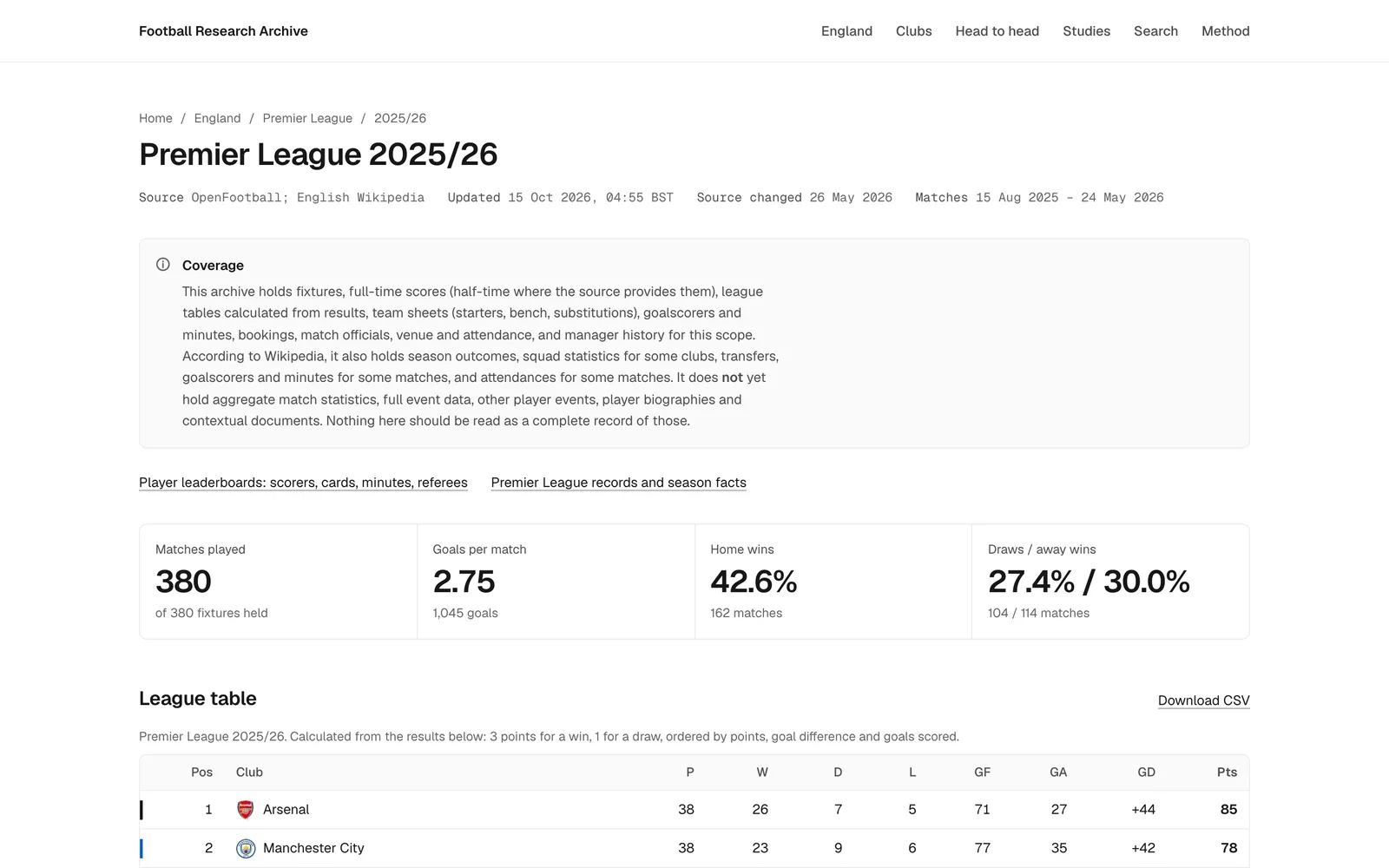
Every season's table, with the current season marked provisional.
The league meetings of any two clubs.
Each sets out its question, method, data cutoff and limits.
What the archive counts, and why.
Each source, its licence and the date that licence was last reviewed.
How to report an error, and how a fix is made and shown.
The archive changes as its sources do, so its counts can move away from the figures on this page, which were read on 23 October 2026.
Statistics are quoted far more often than they are checked. A figure gets copied from one table to the next and loses its source, the date it was taken and how it was counted along the way. When the original source corrects a result, the copies don't change. Nobody can tell which version is right, or why two tables disagree.
Our clients have the same problem with programme figures: an indicator reported to a funder is often several copies away from the record it came from. We wanted a public example of the fix that anyone can open and check.
Licences before data. We record every source's licence and review it before its data is used. Nothing from a source reaches a public page unless its licence permits published derived data. We do not scrape websites or call undocumented APIs, and the raw provider files are stored for audit, never republished.
Checks at the door. Each file is fingerprinted when it arrives and tested for impossible dates and scores, duplicate rows and values that cannot be true. Any row that fails is kept off the public pages. Importing the same file a second time changes nothing.
Matching without guessing. A club is joined to its record through a known identifier, or through an exact name within the right country, and in no other way. Where a match is uncertain, an editor decides.
Calculate, then check. League tables are worked out from the results under each season's points rules. Results files say nothing about points deductions, so an editor checks every season for them before its table goes live and records each deduction with its official source.
Corrections in the open. If a source later fixes a result, the change is kept as a revision and the match page notes it. Studies are never edited silently: a correction publishes a new version with a public revision note.
Statements labelled by kind. Pages keep documented facts, claims made by third parties and our own editorial reading apart, and say which is which. Studies report patterns within a stated period and stop short of claiming causes.
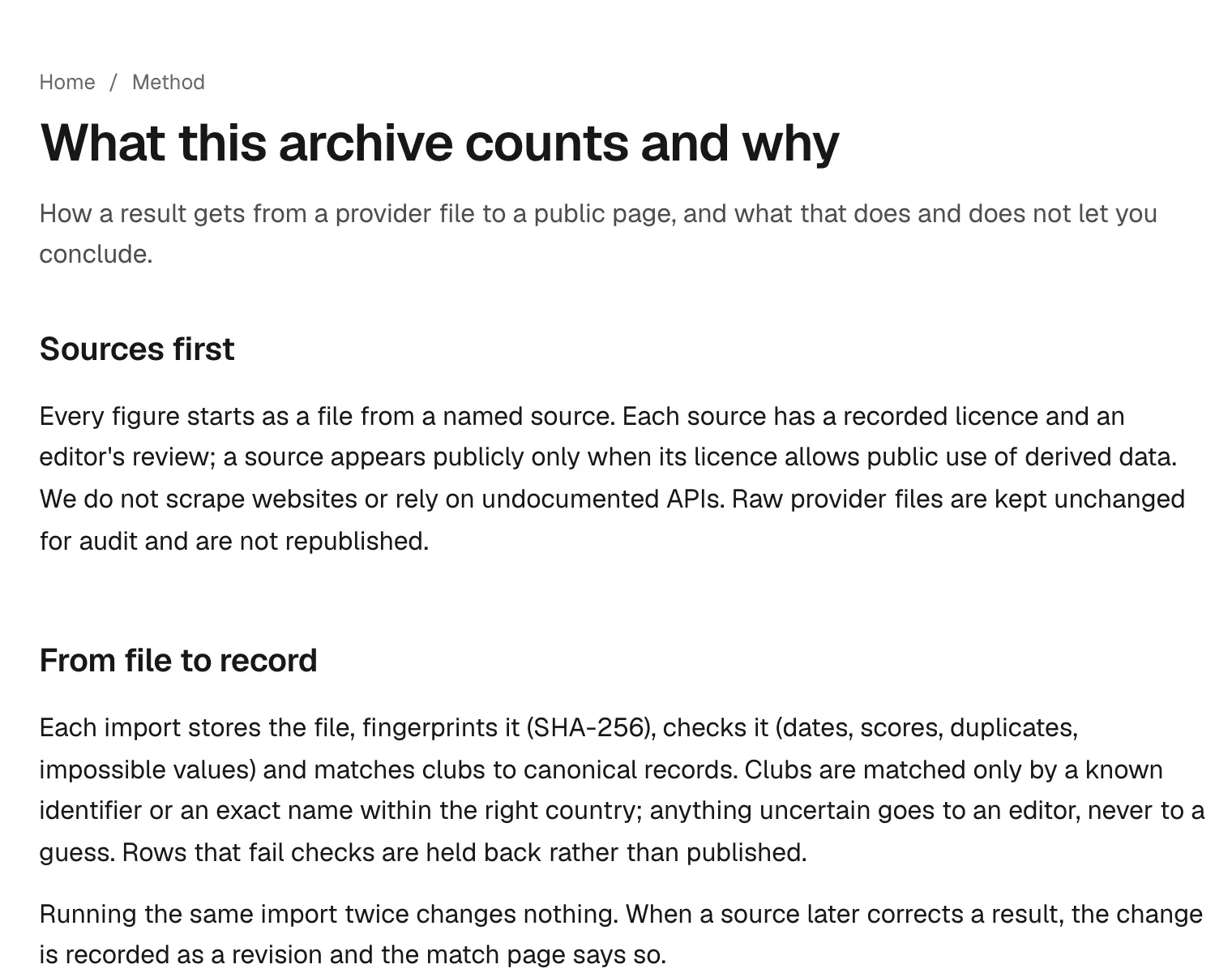
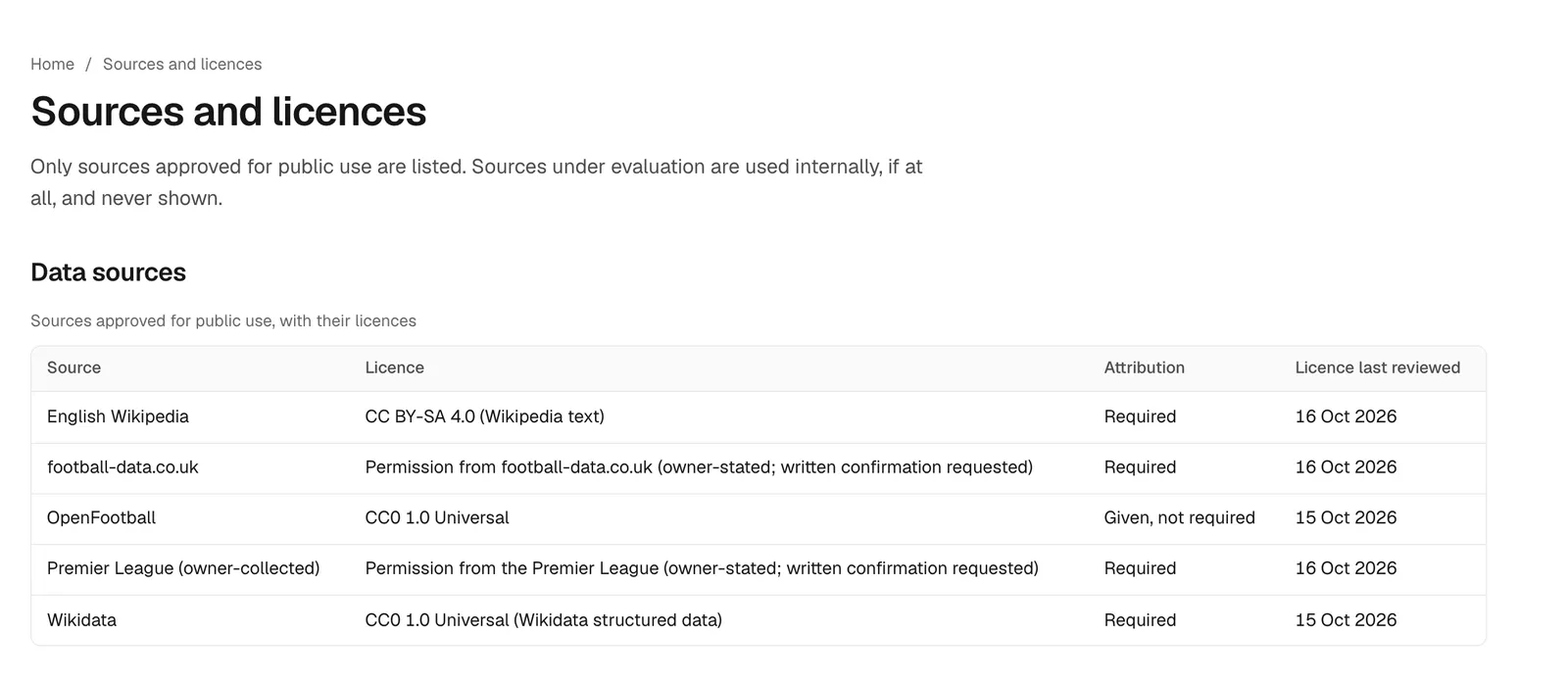
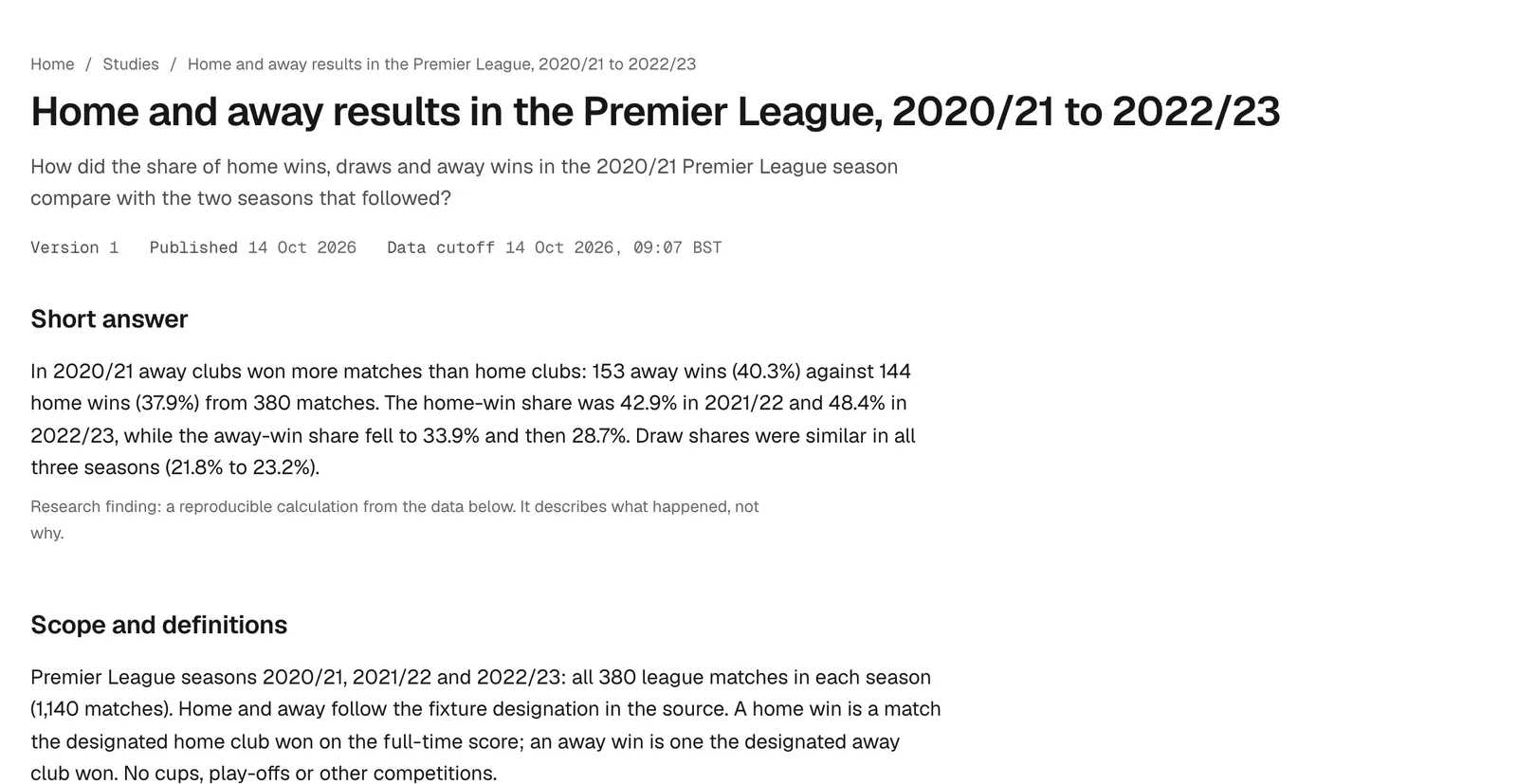
Read from the archive on 23 October 2026. Licences last reviewed 15 and 16 October 2026.
A reader can follow any number on the archive back to its source and the date it was imported, and see the method behind it.
A correction at the source flows through on the next import, with a note saying what changed. There is one version of each figure, not several copies.
The same sequence of licence check, import checks, careful matching, calculate then check, and visible revisions is what we build for programme data: partner reports, indicator tables and public dashboards.
The archive covers one competition so far. Player-level data exists for 2025/26 alone; for earlier seasons it holds results only. A blank means the archive has no value for that statistic, not a zero. Two of the five sources are used on their owners' stated permission, and written confirmation has been requested. The archive gives no live scores and no betting information.
The working system, built and handed over, with the trail back to source intact.
Traceability
A working method for keeping every claim in a report linked to the source behind it, from intake to sign-off.
Traceability
The control table behind an evidence-heavy report, with fields, source ID rules, quality checks and a copyable template.
Tell us what you are working with. We will tell you plainly whether we are the right fit.
Tell us what you are working with and what it has to answer. We will tell you plainly whether we are the right fit.
Choose a time (opens in a new tab) The call is on Google Meet. Bookings are handled by Google Calendar, which may set its own cookies.