Case studies / 06
6,869 Truth and Reconciliation Commission records, catalogued and linked back to their source
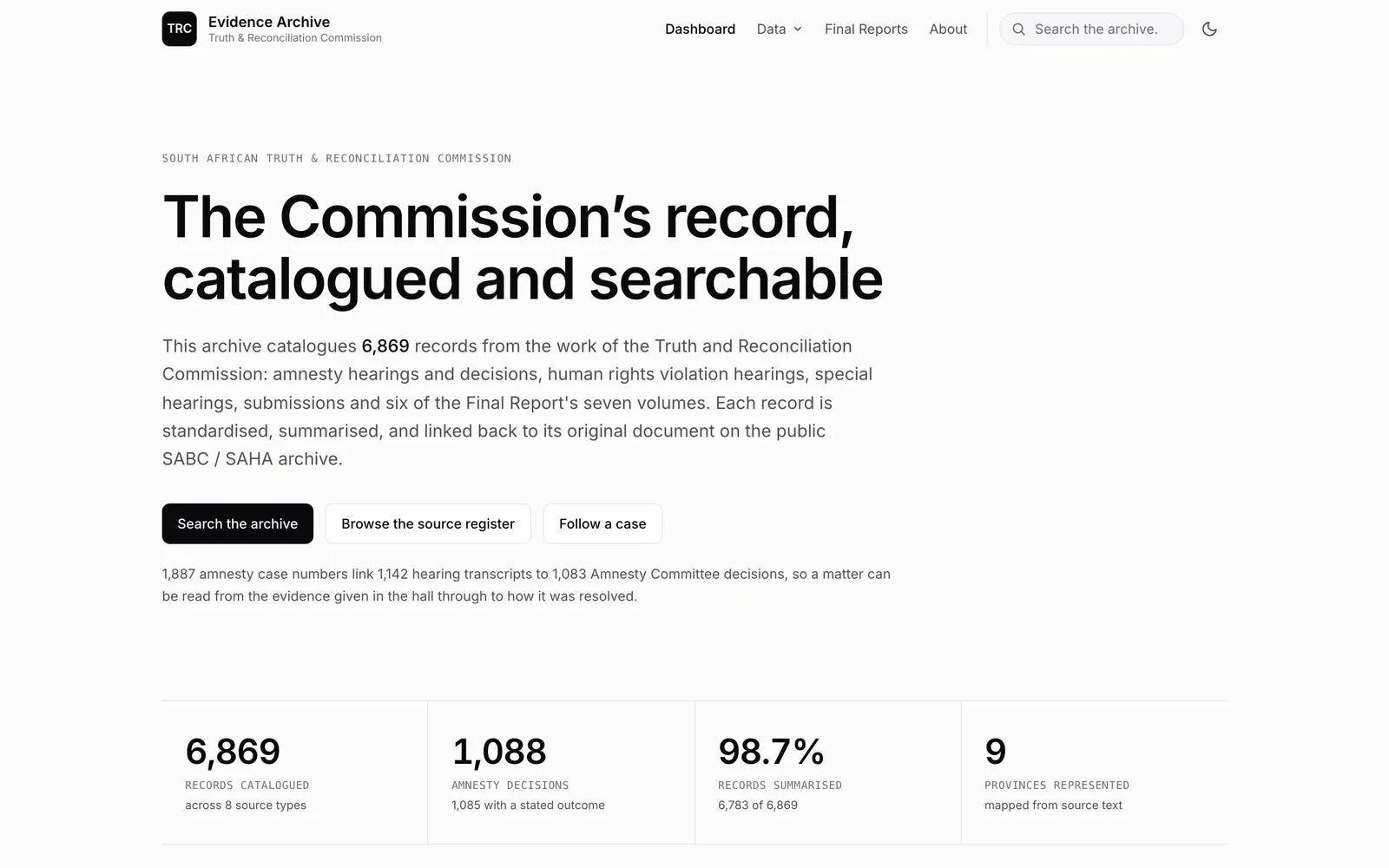
We built a public archive of the Truth and Reconciliation Commission's record as our own project. Every record is catalogued, summarised and linked to the original document, and amnesty hearings are joined to the decisions that resolved them.
- Client
- Evidence Systems (our own project)
- Funded by
- Evidence Systems. No client commissioned this work
- Period
- July 2026 to date
- Our role
- Collection, cataloguing, case linking and the public archive
- Service
- Data System Build
- Status
- Live. Catalogue version 1.0
- Source
- SABC and South African History Archive, Truth Commission Special Report
- Archive
- trc.evidencesystems.co.za
Live platform
TRC Evidence Archive
The archive is public. Search it, follow an amnesty case from hearing to decision, or open any record's original document.
-
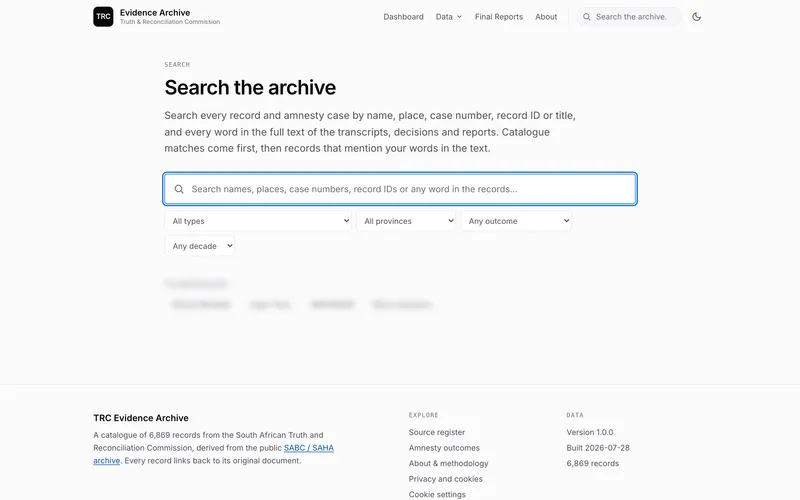
Search
Find a record by name, place, case number or record ID.
-
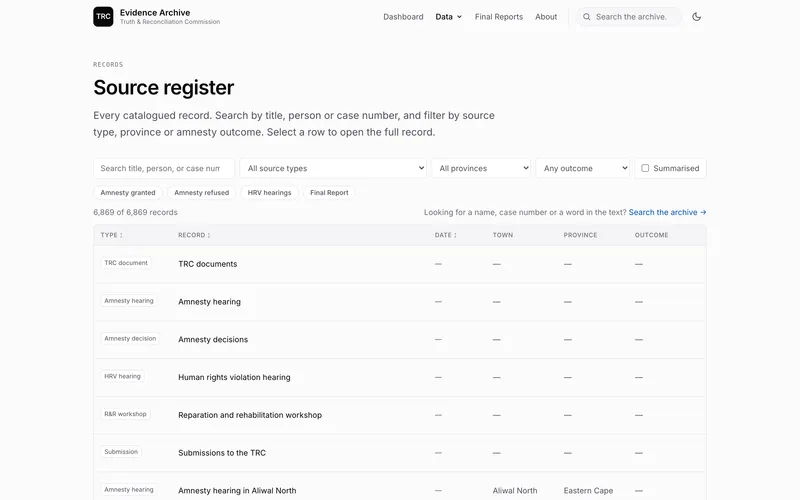
Source register
All 6,869 records, filtered by type, province and outcome.
-
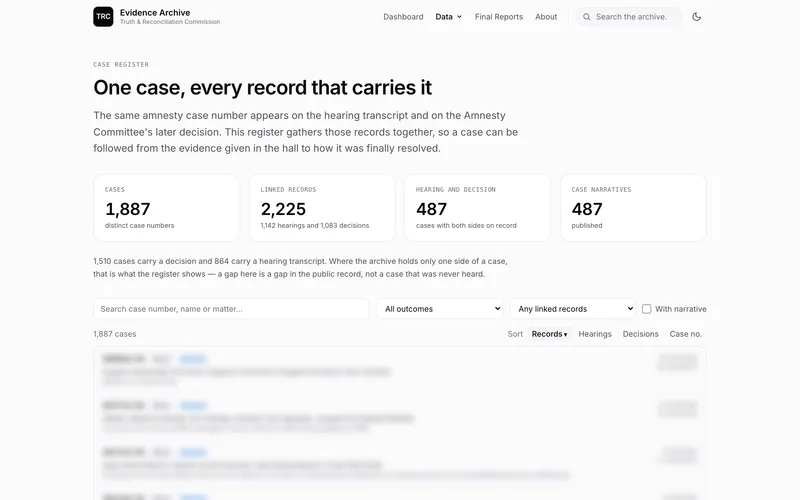
Case register
1,887 amnesty case numbers, with the hearings and decisions that carry each one.
-
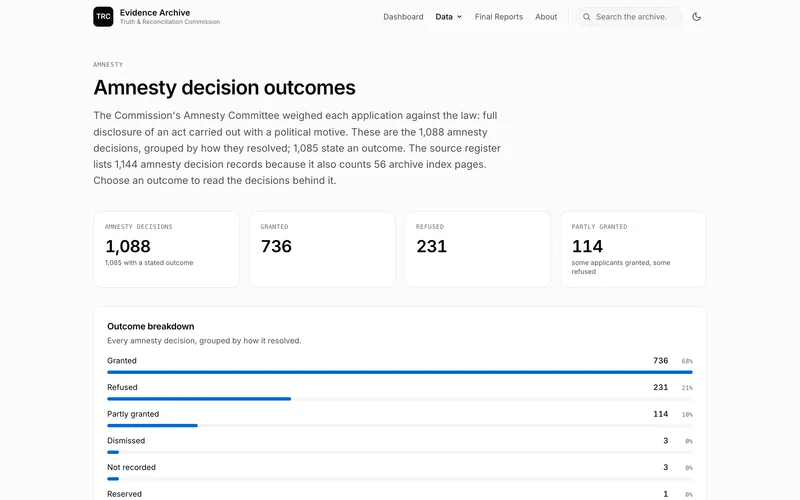
Amnesty outcomes
Amnesty decisions grouped by how they were resolved.
-
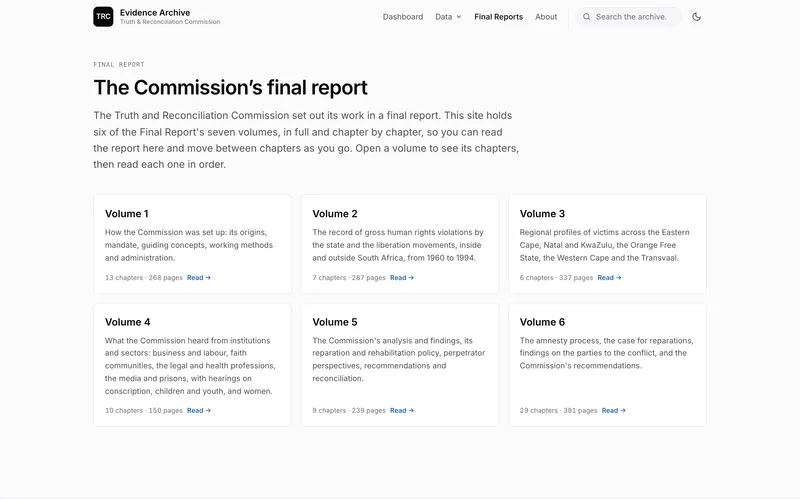
Final Report
Six of the Final Report's seven volumes, chapter by chapter.
-
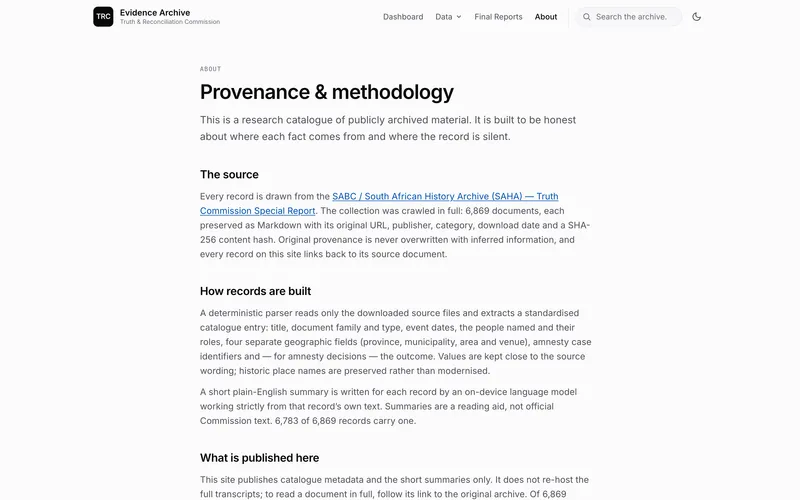
Method and sources
Where every record comes from, how it was built and what it leaves out.
The archive is a research catalogue. Summaries are a reading aid, not Commission text, and records have not been checked by hand one by one.
The problem
The SABC and the South African History Archive publish the Truth and Reconciliation Commission's record online as the Truth Commission Special Report. It holds hearing transcripts, amnesty decisions, submissions and the Commission's Final Report across thousands of web pages.
You can read any page. You cannot easily count, filter or follow a matter through it. An amnesty application is heard in one document and decided in another, and the case number that ties them together is not a link. Places use the names of the time, and the same person is often spelt several ways.
We wanted a public test of our method on a record that anyone can check. This one is large, public, sensitive and inconsistent, which makes it a fair test. It is also a record that researchers and the public should be able to use more easily.
What we did
We collected the whole collection: 6,869 documents, each kept with its original address, publisher, category, download date and a content fingerprint, so any record can be checked against its source.
A parser with fixed rules read only those downloaded files and built one catalogue entry for each document: title, document type, event dates, the people named and their roles, four separate place fields, amnesty case numbers and, for decisions, the outcome. Values stay close to the source wording. Historic place names are kept. Where a source does not state something, the field is left blank rather than guessed.
A language model running on our own machine wrote a short plain-English summary of each record, working only from that record's text. 6,783 records carry one. The site labels them as a reading aid.
We then joined hearings to decisions through their amnesty case numbers, so a matter can be followed from the evidence given at the hearing to the Amnesty Committee's ruling.
The site publishes the catalogue and the summaries only. It does not re-host the transcripts, because the testimony is sensitive and belongs to the original archive. Every record links back to its source document.
- 6,869 source documents
- 6,869 catalogue records
- 1,887 amnesty case numbers
- 1 public archive
What we built
- A catalogue of 6,869 records across eight source types
- A source register filtered by type, province and amnesty outcome
- A case register of 1,887 amnesty case numbers, joining hearings to decisions where both are on record
- Amnesty decisions grouped by outcome, with each outcome read from the decision text
- Six of the Final Report's seven volumes, readable chapter by chapter
- Search by name, place, case number, record ID, title or summary
- A methodology page that states the source, the method and the limits
The work in figures
- 6,869 records catalogued
- 8 source types
- 6,783 records with a plain-English summary
- 1,887 amnesty case numbers
- 487 cases with both hearing and decision on record
- 1,088 amnesty decisions, 1,085 with a stated outcome
- 74 Final Report chapters, in six of its seven volumes
- 9 provinces, mapped from the source text
As at October 2026, catalogue version 1.0.
What changed
Anyone can now start from a name, a place or a case number, see every record that carries it, and open the original document. An amnesty case can be followed from hearing to decision in one place.
For the organisations we work with, the archive shows our method on a record they can check for themselves: every figure points to a source document, and a gap in the record is shown as a gap.
Limits
Records were standardised automatically and have not been checked by hand one by one. Search covers the catalogue and the summaries, not the full text of transcripts. Summaries are a reading aid, not Commission text. The site says all of this.